
In anticipation of our upcoming training, "Using Creativity to Heal from Weight Bias: A Trauma-Informed, Art-Informed IFS Approach," I’m pleased to introduce presenters Peggy Kolodny and Salicia Mazero who share their insights on how art therapy and Internal Family Systems can help clinicians address weight bias, body shame, and the lasting impact of internalized stigma. In this post, they explore how creativity can offer clients a compassionate path toward healing, self-understanding, and deeper connection with their bodies.
Weight bias is one of the most common — and often least discussed — forms of stigma that clients carry into therapy. People in larger bodies frequently experience negative assumptions, discrimination, and subtle microaggressions in everyday life, including in healthcare, education, workplaces, and media. Over time these experiences can become deeply internalized, shaping how individuals view themselves, their bodies, and their worth. Many clients arrive in therapy carrying layers of shame, self-criticism, and painful beliefs about their bodies. In our workshop, "Using Creativity to Heal from Weight Bias: An Art-Informed Internal Family Systems Approach," we explore how integrating art therapy with Internal Family Systems (IFS) can offer a compassionate and powerful pathway for helping clients process these experiences and reconnect with themselves.
Weight bias tends to operate on several levels. There is explicit bias, which includes openly expressed negative attitudes or discriminatory behaviors toward individuals based on body size. There is also implicit bias, which refers to unconscious assumptions that can influence how people interact with others — including clinicians. But perhaps the most painful form is internalized weight bias, when individuals absorb cultural messages about body size and begin to believe them about themselves. Clients may carry internal narratives such as “I’m not disciplined enough,” “My body is wrong,” or “I’ll be worthy when I lose weight.” These beliefs can fuel eating disorder behaviors, body dissatisfaction, and an ongoing sense of inadequacy.
Art allows clients to access emotional and sensory experiences that may be difficult to verbalize...
Taking a trauma-informed approach to this work is essential. Many individuals have experienced repeated body-based shaming, bullying, medical stigma, or social rejection related to their weight. These experiences can activate the nervous system and become stored as implicit, sensory memories rather than coherent stories. As many trauma clinicians know, when experiences are overwhelming or humiliating, the brain’s language centers may shut down, making it difficult to put feelings into words. This is where creative expression can be particularly helpful. Art allows clients to access emotional and sensory experiences that may be difficult to verbalize, offering a safe and symbolic way to explore what they are feeling.
Internal Family Systems offers a compassionate framework for understanding how these experiences become organized within the psyche. IFS proposes that our internal world is made up of multiple parts — each with its own role, perspective, and protective function — along with a core Self that embodies qualities such as curiosity, compassion, calm, and creativity.
Art therapy offers a natural bridge for helping clients access and understand their parts. When clients represent parts visually — through drawing, collage, or sculpture — they can literally place their internal experiences outside of themselves and observe them with more curiosity and less overwhelm. Art also provides emotional distance and containment, making it easier to explore painful experiences safely.
In this workshop, participants will engage in several experiential art activities that help illustrate how art-making can deepen the IFS process including:
- Body tracing and body outline exploration
- A body scan from multiple parts
- Artwork representing manager, critic, and firefighter parts in clay, depicting urges without acting on the behavior
- Polarized parts artwork
- Artwork exploring protective parts that guard vulnerable exiles
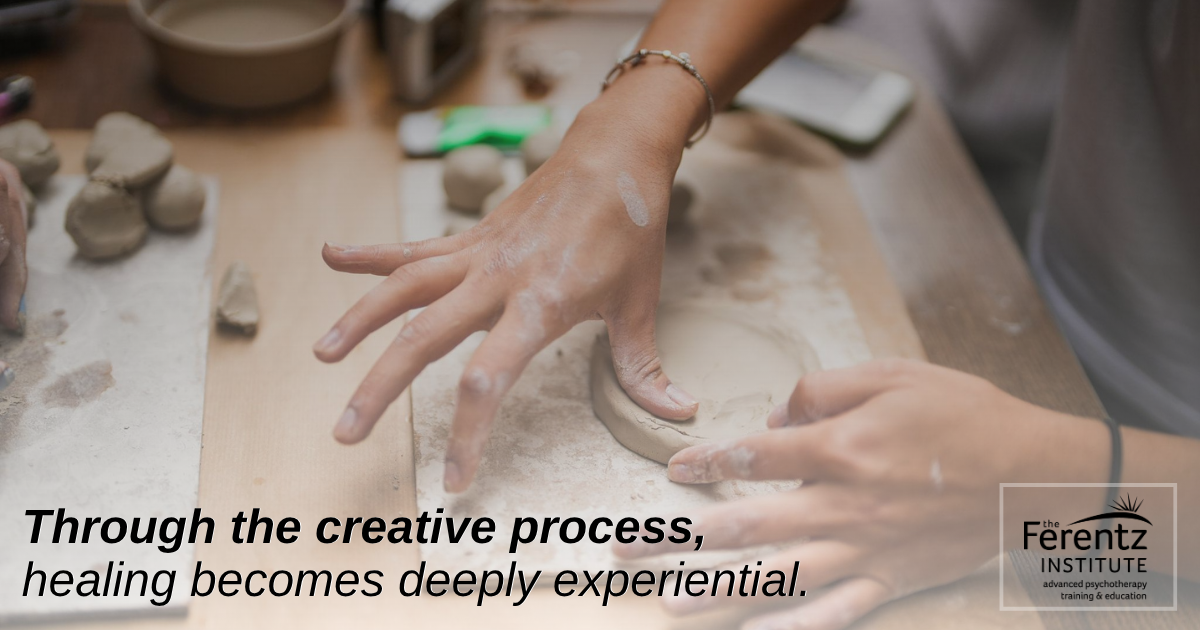
Ultimately, integrating art therapy with Internal Family Systems offers clinicians a compassionate and flexible way to address the deeply embodied experiences of weight bias and body shame. When clients are invited to explore their internal world through creativity, they can begin to externalize internalized stigma, develop curiosity toward their parts, and cultivate greater self-compassion. Through the creative process, healing becomes not only possible but deeply experiential — allowing individuals to reclaim their bodies as spaces of resilience, connection, and belonging.
No formal training in Art Therapy or IFS is needed for this workshop.
Using Creativity to Heal from Weight Bias: An IFS-Informed Art Approach
Tuesday, May 5
Virtual on Zoom
Earn 6 Implicit Bias CEUs

Peggy Kolodny, MA, ATR-BC, LCPAT, is a board-certified, licensed art psychotherapist and founder of the Art Therapy Collective in Owings Mills. Specializing in trauma treatment across the lifespan since 1982, she integrates art therapy with EMDR and Internal Family Systems (IFS) to support deep healing and recovery. Peggy serves as adjunct faculty for graduate art therapy programs at George Washington University and Florida State University and presents workshops internationally. She is also an appointed board member of the International Society for the Study of Trauma and Dissociation (ISST-D) and has contributed extensively to publications on trauma, dissociation, EMDR, and art therapy.

Salicia Mazero, MA, LPC, ATR, CEDS-S, is a licensed professional counselor, registered art therapist, and certified eating disorder specialist based in St. Louis, Missouri. She specializes in treating eating disorders, trauma, anxiety, and depression, integrating art therapy with EMDR and Internal Family Systems (IFS). She is the founder of Creating Your Journey, LLC, a faculty member at The Ferentz Institute, and presents nationally on art therapy, IFS, and eating disorder treatment.
References
Catanzaro, J. (2024). Unburdened Eating: A Trauma-Informed and Internal Family Systems Approach to Healing Your Relationship with Food.
Kolodny, P. (2026). Active Imagination: Jungian Underpinnings in the Joining of Art Therapy, Internal Family Systems, and EMDR. In D. Polidi (Ed), IFS Informed EMDR: Creative and Collaborative Approaches. Routledge.
Kolodny, P., & Mazero, S. (2023). The Interweave of Internal Family Systems, EMDR, and Art Therapy. In E. Davis, J. Fitzgerald, S. Jacobs, & J. Marchand (Eds.), EMDR and Creative Arts Therapies (pp. 208–240). Routledge.
Schwartz, R., & Sweezy, M. (2020). Internal Family Systems Therapy (2nd ed.). Guilford Press.