
Internal Family Systems (IFS) is more than just a technique; it’s a compassionate philosophy of living. In this deep-dive interview, expert therapist and consultant Hetty Barnett explains how therapists can transform their practice by shifting from a "diagnostic" mindset to a "Self-Led" approach. Using the detailed case study of "Susan," we explore how to identify "protector" parts, practice somatic un-blending, and lead both our clients and ourselves from a place of "Self-Energy."
Why IFS Changes the Clinician
As a Certified Internal Family Systems Therapist with over fifteen years of experience, I have the privilege of working with many clinicians seeking to understand how IFS can help them and their clients. I know with confidence that when therapists really "get" this model inside of themselves, the growth and change they are able to guide their clients through becomes much deeper and long-lasting. This model transforms lives, heals decades of pain, and—perhaps most importantly—helps the therapist find a sense of peace in their own work.
To demonstrate these concepts, I will be referencing "Susan," a composite client based on many therapists I have coached. Susan was highly successful and professionally respected, yet she felt a growing sense of emptiness and sudden bursts of reactive anger that left her feeling ashamed.
1. Shifting from Pathology to "Positive Intent"
Q: In the IFS model, you suggest that even self-destructive parts have a "positive intent." For clinicians trained in traditional diagnostic models, this can feel counterintuitive. How do you explain this shift?
Hetty: It is a radical departure from the "fix-it" mentality. In traditional models, we often see symptoms—like Susan’s anger—as problems to be suppressed or eliminated. In IFS, we view these as "parts" of the personality that have taken on extreme roles to protect the individual from pain.
When we approach a client’s reactivity as a protective system rather than a pathology, the entire power dynamic changes. The relationship moves from a "doctor/patient" or "fixer/problem" dynamic to a collaborative partnership. We aren't trying to "get rid" of anything; we are trying to understand its role.
The Case of Susan: When Susan first came to me, she judged her anger harshly. She saw it as a flaw that made her a "bad therapist" or a "bad mother." By shifting to a non-pathologizing lens, Susan began to see her anger as a "troll" standing guard. We discovered this troll was actually protecting a very young, sad, and lonely "exile" part of her from her childhood. Once Susan stopped fighting the "troll" and started being curious about what it was protecting, the anger began to soften.
2. Somatic Awareness and the "Four Corners" of Un-blending
Q: You mention that for healing to occur, a client must "un-blend" from their parts. How do you use the body to facilitate this?
Hetty: "Blending" is when a part completely takes over a person’s system. If Susan is "blended" with her anger, she is the anger. In that state, there is no "Self" available to do the work. Un-blending is the process of creating space so the "Self" can observe the part.
By simply noticing the physical sensation of the "troll" in her jaw, Susan could acknowledge it. I asked her, "Can you ask that part to give you just a little bit of space so you can get to know it?" This is the portal to un-blending.
- The Body: We look for "portals." I ask, "Where do you feel that anger in your body right now?" Susan felt it as a heat in her chest and a clenching in her jaw."
- The Mind: We notice the "thought headlines." Susan’s mind was racing with "I can't believe he did that again!"
- The Spirit: We acknowledge the "Self-Energy"—the calm, quiet observer that is noticing the heat and the thoughts.
- Relationships: We look at how these parts are interacting with others.
3. Mastering the "U-Turn" in Relationships
Q: You are an expert in Intimacy from the Inside Out (IFIO). One of the most powerful tools you mention is the "U-Turn." How does this work in a clinical or personal setting?
Hetty: Most of us are "externally focused" when we are upset. We focus on what our partner, colleague, or client did "wrong." The U-Turn is the courageous act of turning our attention inward during a moment of conflict.
Instead of Susan focusing on her spouse "dropping the ball" with the dishes, she practiced a U-Turn. She looked inside and realized her anger was triggered because she felt "ignored"—a feeling that belonged to her younger "exile" part.
When she made the U-Turn, she stopped blaming her spouse and instead comforted the little girl inside her who felt ignored. This allowed her to speak for her anger rather than from it. She could say to her spouse, "I'm feeling a part of me get very reactive because I feel ignored right now," rather than shouting, "You never help me!" This is how we create external intimacy—by first achieving internal intimacy.
"The emptiness you feel is actually just the absence of your Self."
4. Accessing the "8 C’s" and the Spirituality of the Self
Q: You’ve said that IFS bridges the gap between psychology and spirituality. What does "Self-Energy" actually feel like for a therapist?
Hetty: The "Self" is the seat of consciousness. It is the compassionate, wise leader of our internal system. We know we are in "Self" when we feel the 8 C’s:
- Curiosity, Calm, Compassion, Clarity, Confidence, Courage, Creativity, and Connectedness.
Many clients describe this as a spiritual experience—feeling a "Spark of the Divine" or "Transcendent Wisdom." For Susan, reaching this state meant she no longer felt empty. She realized that the "emptiness" she felt was actually just the absence of her Self. Once she learned to un-blend from her protectors, her internal world felt populated, warm, and connected.
5. Self-Leadership: The "5 P’s" for the Clinician
Q: Clinical work is exhausting. How does a therapist stay "Self-Led" when they are triggered by a difficult client?
Hetty: We have to lead ourselves before we can lead others. I encourage therapists to look for the 5 P’s of Self-Led Leadership:
- Presence: Being fully "with" the client without an agenda.
- Patience: Trusting the timing of the client’s system.
- Perspective: Keeping the "big picture" of the client's protective system in mind.
- Persistence: Not giving up on the "difficult" parts.
- Playfulness: Bringing a sense of lightness and creativity to the work.
When I feel my own chest tighten in a session, I know a "protector" part of mine has stepped in—perhaps a "fixer" part that feels I'm not doing enough. I take a long outbreath and silently ask that part to step back, reminding it that "Slow is fast." By slowing down and trusting the process, the session naturally goes deeper.
Conclusion: Coming Home to Yourself
Q: What was the ultimate outcome for Susan, and what is your hope for other therapists reading this?
Hetty: Over time, Susan’s sessions with her own clients shifted. They became lighter and more enjoyable because she was leading with curiosity rather than the pressure to "fix." She showed up with more clarity and was calmer when her clients presented with their own "angry trolls."
Susan wasn’t just managing her symptoms anymore; she was "coming home to herself." My hope for every clinician is that they realize they don't have to carry the burden of their clients alone. When you lead from "Self," you are tapping into a wellspring of compassion that nourishes both you and the person sitting across from you.
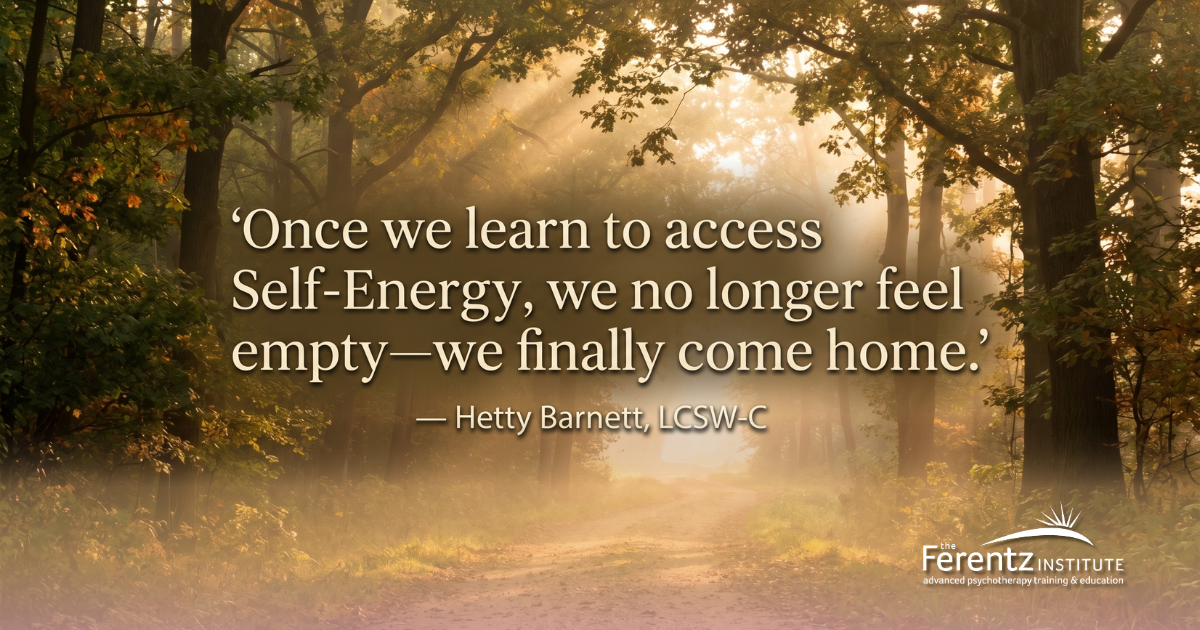
Once you learn to access Self-Energy, the way you relate to the world is fundamentally transformed. You are no longer feeling empty; you have finally come home.
Self-led Clinical Skills: Introduction to IFS
Friday, May 29
Live and In Real Time on Zoom
Earn 3 CEUs
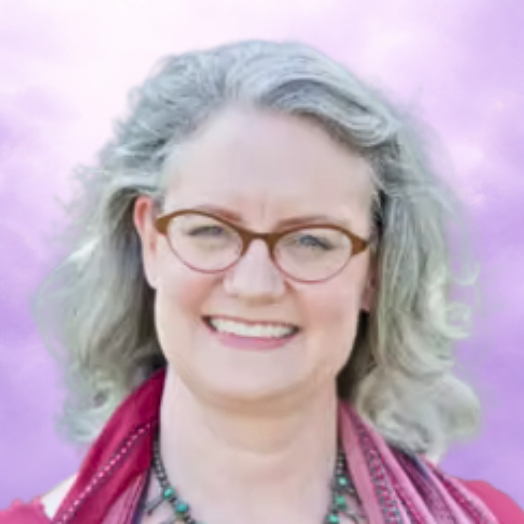
Hetty Barnett, LCSW-C, is a Certified IFS Therapist and Consultant with over 15 years of experience at the intersection of psychology and spirituality. She holds a Master of Arts in Social Service Administration from the University of Chicago and a Master of Theology from the Lutheran School of Theology at Chicago.
Specializing in Intimacy from the Inside Out (IFIO), Hetty has served as staff for numerous trainings and is owner and director of Four Corners Counseling & Well-Being in Silver Spring, Maryland. There, she provides individual and couples therapy alongside clinical consultation for therapists.
Known for her intuitive approach, Hetty is dedicated to helping clinicians access Self-energy to lead with clarity and courage. She believes that by connecting with the Self, we move beyond emptiness and finally "come home."